Can an assistant remember the reason?
A saved preference is only a starting point. The book asks what it would take to recover context, notice a changed decision, and admit what is missing.
Try the AI workflow →Personal Intelligence Without Surrendering Your Judgment
An assistant can give you an answer. What will you keep deciding for yourself?
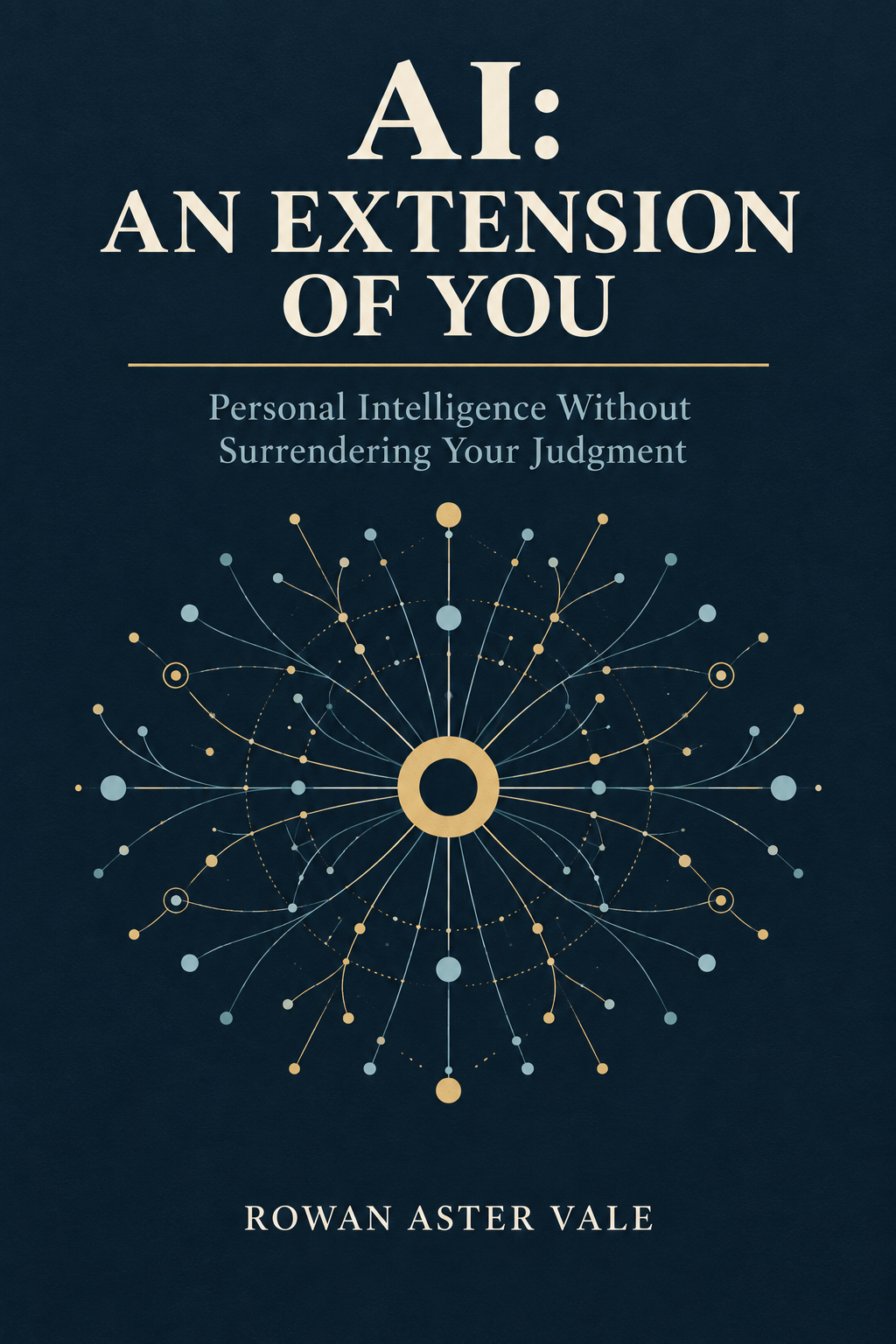
A polished answer can leave the real work untouched. This short nonfiction book explores what personal AI would need to understand about a project: the reasons behind decisions, the standards worth keeping, and the moments when a human choice matters most.
Across fifteen chapters, Rowan Aster Vale connects memory and creative work with classrooms, jobs, privacy, and the risks of more capable systems. The thread is practical and hopeful: how could assistance expand what people can attempt while leaving them responsible for what they choose?
Human ideas and direction; AI assistance with drafting, research, revision, and cover art. This page is original promotional commentary. No manuscript excerpts or reading files are hosted here.
A saved preference is only a starting point. The book asks what it would take to recover context, notice a changed decision, and admit what is missing.
Try the AI workflow →Several confident answers can still share an error. Questions about evidence, independent checks, and extra reasoning run through the book.
Read our source guide →For children, creators, and people at work, an immediate result is part of the picture. The book considers what happens to understanding and choice.
Explore AI and learning →These independent reading links connect to the book’s questions. Each offers something specific; none endorses the book or settles every question about AI.
This study tested how the position of information affected question answering and retrieval. Its results concern the systems and tasks tested, rather than establishing how every current or future assistant remembers.
A randomized study examined AI guidance for human tutors. The reported improvement in student topic mastery concerns that supported tutoring setting; it does not show that an unattended chatbot can replace a teacher.
A voluntary framework companion for thinking about risks across the life of a generative AI system. This additional reading is guidance, not a certification of any assistant or a finding that its risks have been eliminated.
Source descriptions checked October 1, 2026. Links open the original publisher’s page. The first book’s source guide covers evolution, screen attention, and the illuminated shore.
No. This book stands on its own. Almost Completely Written By AI explores evolution, attention, and attractive signals. This second book focuses on personal AI and human judgment.
It is written for general readers, with concepts and examples explained in the text. It is a short reflective book about using and judging assistance, rather than a programming manual or a catalog of prompts.
See the Kindle edition or the 70-page paperback. Amazon lists an October 2, 2026 publication date. Check its storefront for current availability, prices, and Kindle Unlimited eligibility; these can vary by country and account.