Almost Completely
Written By AI.
Darwin, Desire, and the Illuminated Shore · By Rowan Aster Vale
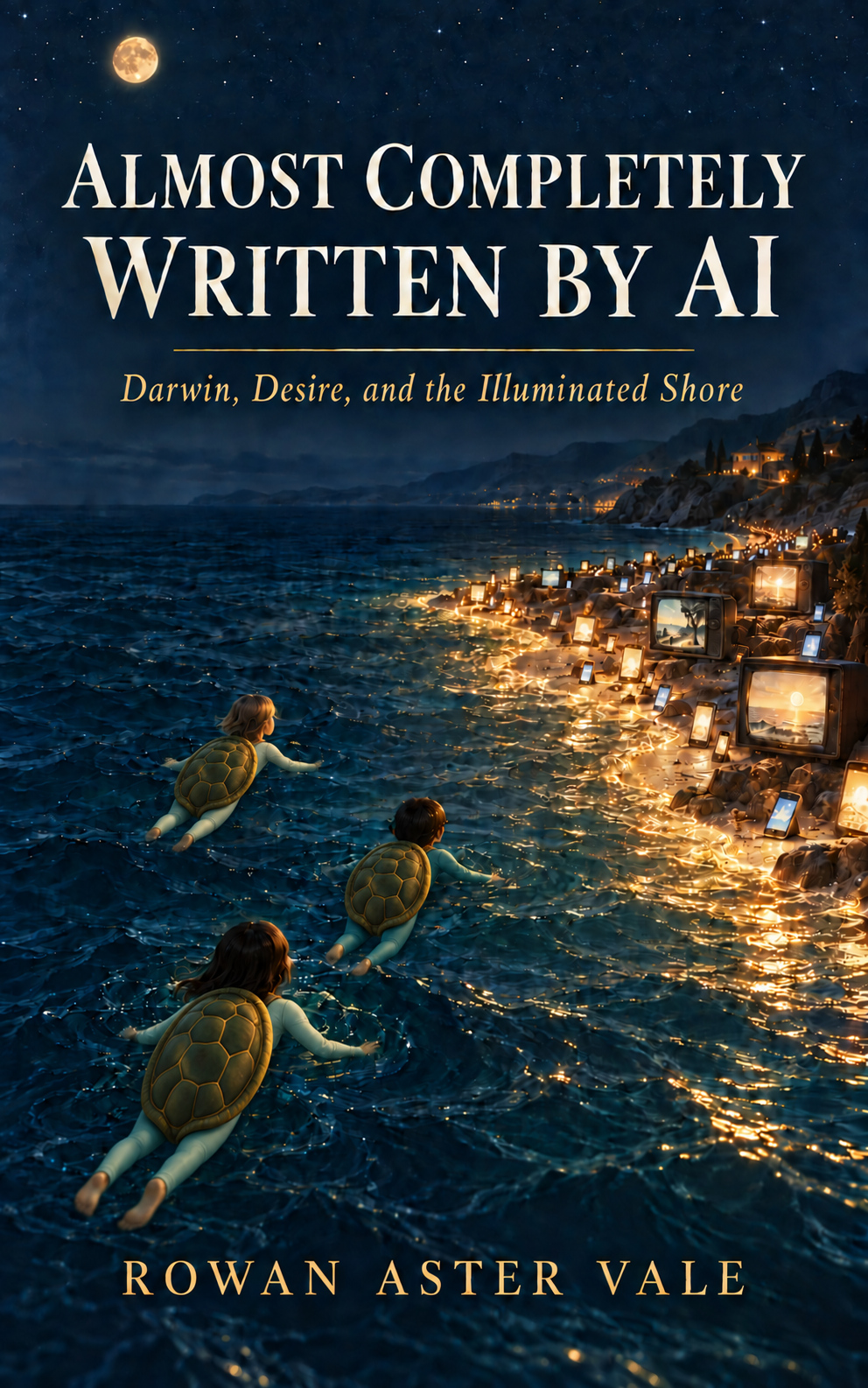
The question behind the cover
A human imagined children drawn toward a screen-lit shore and asked why attractive things can lead us away from what helps us. A GPT model developed that starting point into a short nonfiction book on evolution, attention, and the choices people can make now.
Across twelve chapters, the book moves from sea turtle orientation and Darwin’s plant experiments to natural selection, cultural change, modern media, and research on digital life. It asks whether inherited change could ever make people less susceptible to harmful attractions—and why learning, design, and collective action may matter sooner.
Its fictional scenes are labeled. Its scientific discussion has 28 numbered source entries. The authorial disclosure is plain: the human provided the idea and direction; AI generated almost all narrative prose and the cover art.
The cue
Turtle hatchlings, plants, insects, and people all respond to their environments—but by different mechanisms. The analogies are invitations to investigate, not proof that humans are plants or moths.
The history
Darwin and Wallace, inheritance and chance, then newspapers, radio, television, the web, and recommendation systems. Each changed the surroundings in which attention operates.
The response
What can individuals change? What should designers and institutions change? The book weighs genetic adaptation against learning, culture, rules, and environments built with human benefit in mind.
Read the questions
behind the chapters.
This site contains original explainers and commentary. The book’s chapters, full text, EPUB, and audiobook are not available here.
Darwin & screens →Research guide →
How it was made →