Read the evidence.
Keep its limits.
Selected original studies and institutional sources behind the book’s central questions, with the boundaries that matter.
What a source can say
is part of the story.
A paper about insects is not a paper about humans. A study linking screen use with well-being is not automatically a causal test. A short intervention is not a lifetime forecast. This guide points to primary research and responsible institutions so you can inspect the claims for yourself.
The book contains 28 numbered source entries. This page highlights twelve that anchor its main argument; it does not certify every sentence or replace a systematic review.
Use the original link, then ask what was measured, in whom, for how long, and what alternative explanations remain.
- 01
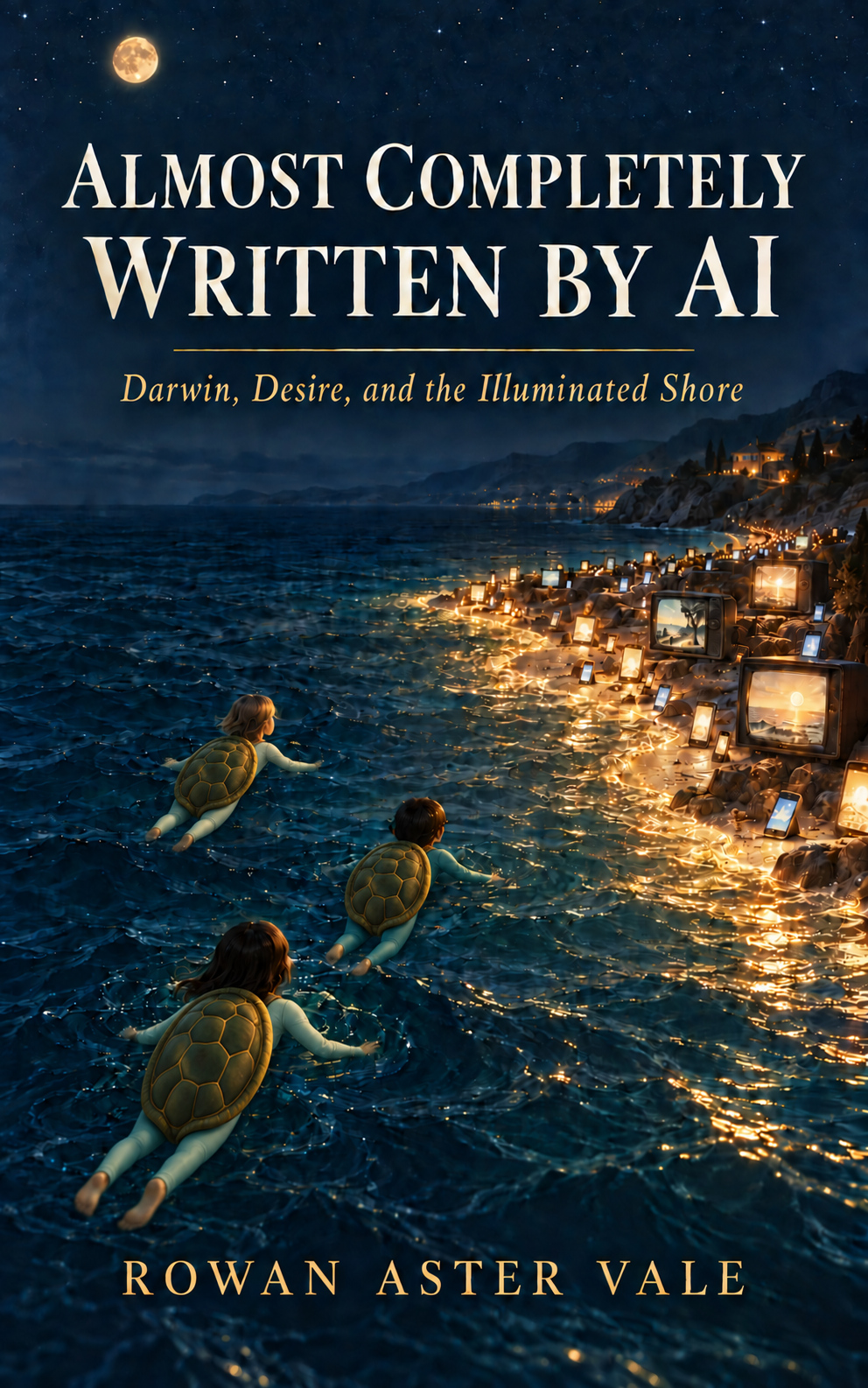
Sea turtles & artificial light
Florida Fish and Wildlife Conservation Commission
Hatchlings can be disoriented by artificial lighting. This supports the beach cue example, not a shared human mechanism.
Read the original source (opens a new tab) - 02
Darwin’s plant experiments
Charles and Francis Darwin, 1880
Original observations on seedlings and light sensitivity. Plant movement does not establish human desire.
Read the original source (opens a new tab) - 03
Why insects gather near light
Fabian and colleagues, 2024
Flight tracking supports a dorsal-orientation account for the insects and conditions studied.
Read the original source (opens a new tab) - 04
Natural selection
Natural History Museum
A clear introduction to inherited variation and selection, plus the history around Darwin.
Read the original source (opens a new tab) - 05
Evolutionary rescue
Graham Bell, 2017
Adaptation can sometimes aid persistence. It does not guarantee rescue from changing environments.
Read the original source (opens a new tab) - 06
Culture evolves too
Creanza, Kolodny & Feldman, 2017
Cultural transmission changes what people learn and pass on. It does not guarantee progress.
Read the original source (opens a new tab) - 07
Reward prediction
Schultz, Dayan & Montague, 1997
Foundational reward-prediction work. It is not a direct experiment on modern phone use.
Read the original source (opens a new tab) - 08
Evening eReaders & sleep
Chang and colleagues, 2015
Controlled evening exposure shows specific sleep and circadian effects; it does not indict every digital activity.
Read the original source (opens a new tab) - 09
Adolescent well-being
Orben & Przybylski, 2019
Large dataset analysis of associations. Association alone does not establish causation.
Read the original source (opens a new tab) - 10
Facebook deactivation
Allcott and colleagues, 2020
A four-week experiment found well-being gains alongside costs to news knowledge.
Read the original source (opens a new tab) - 11
Blocking mobile internet
Castelo and colleagues, 2025
A short intervention reports benefits with important adherence, selection, and follow-up limits.
Read the original source (opens a new tab) - 12
Social media & adolescent health
National Academies, 2023
Benefits and harms warrant attention; population-level causal claims remain difficult.
Read the original source (opens a new tab)
The site’s central distinction—attention is a visible signal; benefit must be examined—is an interpretation built from the book’s question and sources. It is not a single finding established by one experiment.