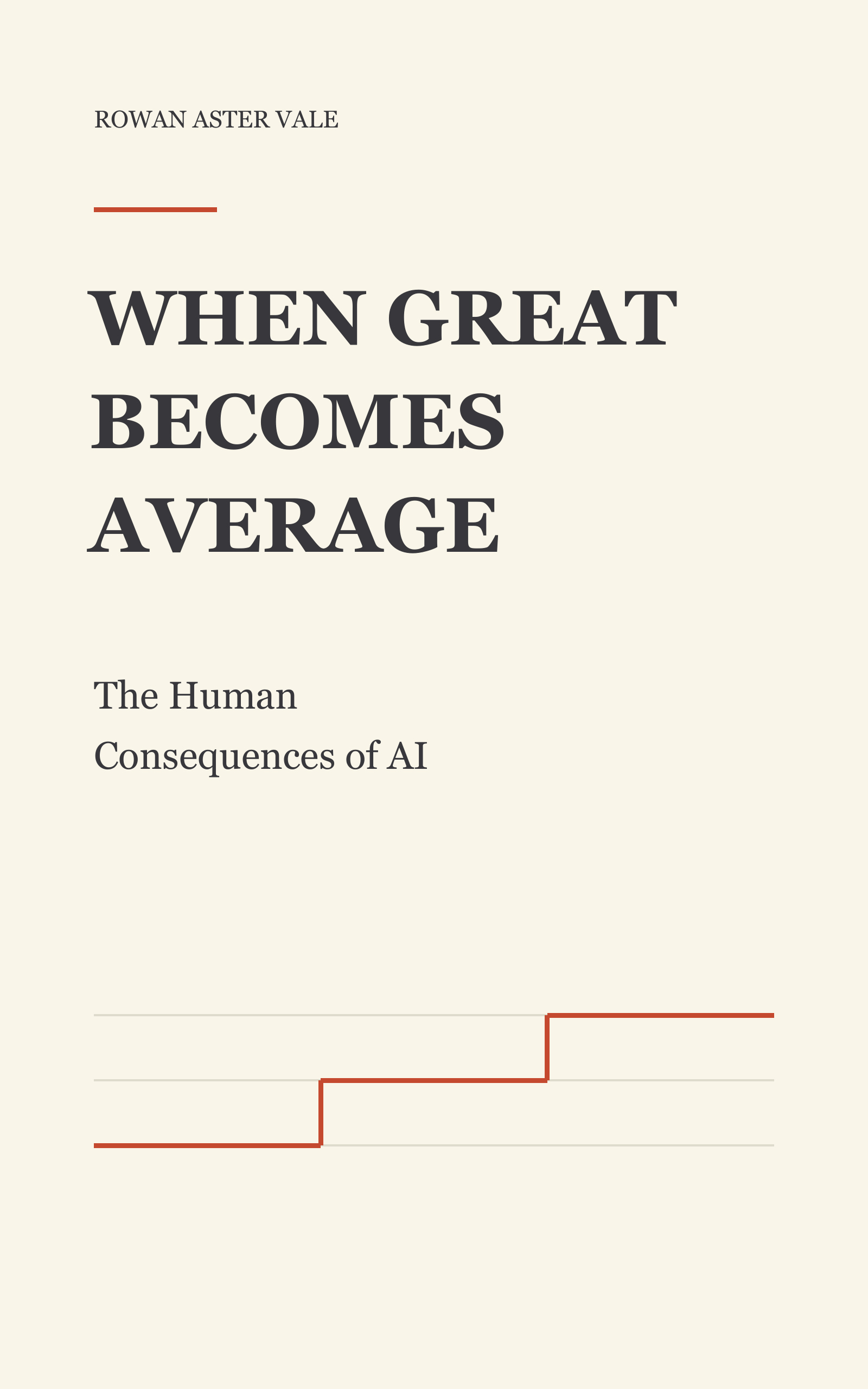
When Great Becomes Average
The Human Consequences of AI
If AI can make excellent work ordinary, what should progress mean for the people living through it?
Standalone nonfiction · 12 chapters · 17 research and historical sources.
Amazon shows current prices and availability.
A rising standard. A human question.
A capability can become commonplace without becoming worthless. Yet people can feel the loss of distinction when a skill that once made them exceptional becomes something almost anyone can access. The book follows the distance between those two facts: better tools can enrich a civilization while unsettling the people within it.
Vale asks who benefits from easier creation, who sets the targets, and how people keep a meaningful say in what happens next. The concern reaches beyond a screen. Work, education, family habits and leadership all help decide whether new capabilities strengthen human lives.
This is a direct, reflective inquiry for general readers. It makes room for uncertainty, opposing arguments and ordinary experience. Its hope depends on choices people can make together, rather than a prediction that technology will automatically lead us somewhere good.
The questions that connect the book
- Creativity and choiceWhen making something becomes easier, which parts of creating still matter to us? Choosing what to make, questioning the result and caring about another person remain substantial work.
- Work and human worthHow should institutions share the gains from greater capability? A person's value cannot depend entirely on having a skill that a machine has not yet acquired.
- Childhood and familyHow do children learn judgment when tools can supply an answer immediately? What habits help a family keep its own attention, relationships and distinctive ways of being together?
- Power and responsibilityWhat should we expect of leaders who shape powerful systems? Good intentions need to be examined alongside incentives, accountability, disagreement and the ability to change course.
Choose a starting point
Start here if you are wondering what improving AI means for the kind of civilization we want to become. Parents, educators, workers, creators and leaders enter through different concerns, but share the question of who gets to choose what improvement is for.
For the practical relationship between a person and an assistant, explore AI: An Extension of You. For attention, evolution and the signals that draw us in, explore Almost Completely Written By AI. Each book stands on its own.
How the book was made
The originating questions, direction and publication decision came from a person. AI assisted with drafting, research, revision and the cover. Source checks and independent criticism helped test the argument; they do not make it infallible. The book includes an authorship note and sources so readers can examine its foundations.
Before you read
Is this a technical book about building AI?
It is nonfiction about AI's human consequences. The focus is work, creativity, learning, family and power. You do not need programming knowledge to enter those questions.
Does “average” mean that everything gets worse?
No. A rising standard can bring real gains. The question is how we understand excellence, dignity and a worthwhile life when yesterday's exceptional capability becomes widely available.
Do I need to read the other books first?
No. This is a standalone companion to the other Vale books. The book guide helps you choose a starting point by subject.
Is the book hopeful?
It looks for hope in human choices and shared responsibility while taking costs and disagreement seriously. The future remains an open question, and readers remain part of it.
Explore the ideas now
These original website guides offer another way into related questions:
- Children, school and AI
- Working well with AI
- Checking AI answers against evidence
- Moonward: a sea turtle game about misleading signals
The game is a metaphor. Our sea turtle and light guide explains the conservation evidence and its limits.