A useful AI writing partner needs something worth helping you say. Your memories, observations, examples, questions, and standards give the work its direction. Start there—even if the first version is messy.
This is a suggested working method, developed from the questions behind this site. It is not a promise of a finished manuscript, a publishing contract, or sales. You can use the feedback stages while writing every sentence yourself.
1. Start with an idea—and the details only you can supply.
Write a short description of the book before asking for prose. Who is it for? What question will it explore, or what experience will it create? What should the reader understand, feel, or be able to do at the end?
Then make a detailed inventory: the main points or events, examples you want to include, things you disagree with, the ending you are working toward, and the parts you are unwilling to lose. Add a few paragraphs of your own writing as a voice reference. Tell the assistant what each example demonstrates; a pile of details without their reasons can be misunderstood.
“A story about a lighthouse keeper” leaves most choices open. “A retired keeper returns during a storm, discovers the lamp was deliberately darkened, and must choose between exposing her brother and warning a fishing boat” supplies a setting, conflict, and consequential choice.
This is an invented planning example, not a passage from either book.
2. Write a rough version of the whole book.
Try a condensed draft—perhaps around one quarter of the length you imagine—covering the main ideas or events from beginning to end. The point is to see the whole progression. A polished first quarter alone cannot show whether the ending has been earned.
One quarter is an optional planning aid, not a formula. Use whatever length makes the structure visible. For nonfiction, explain each chapter’s question, evidence, example, and conclusion in rough form. For a novel, sketch the important scenes, what each character knows and wants, and what changes after each decision.
Mark gaps plainly: “[research needed],” “[reader needs this explained],” or “[I do not yet know why she returns].” These are useful questions. Smooth wording can hide them too early.
3. Use AI for feedback without letting it rewrite your words.
Make the permitted role explicit. Ask it to identify problems and ask questions. Keep the manuscript in your own document with version history, and place feedback alongside it. You decide what enters the text.
Read this as an editor. Give comments only.
Do not rewrite, continue, paraphrase, or replace my prose.
Identify the three places a new reader is most likely to be confused.
For each, point to the passage, explain what is missing, and ask me one useful question.
Preserve my argument, voice, characters, and ending. If you disagree with a choice, explain why rather than silently changing it.
A prompt is a request, not a technical guarantee. If the assistant returns replacement prose, leave it out of your manuscript and repeat the smaller task: identify one unclear passage and explain the problem.
If you later want sentence editing, select a short passage. Request a few minimal suggestions with the original, proposed change, and reason shown side by side. Reject changes that remove meaning, personality, or intentional roughness just to sound more polished.
4. Expand what the reader needs.
Ask what the condensed draft assumes the reader already knows. Add the missing setup, evidence, examples, or scenes. Give an important moment room to happen; remove repeated explanations that do no new work.
For a novel, orient the reader in who is present, where they are, what they want, and what is at stake before relying on a twist. Ask whether a character’s action follows from what they could know at that moment. For nonfiction, check that each chapter answers its own question and prepares the next one.
“What does this reader need in order to understand or care about this part?” is a better test than a page-count target.
5. Check continuity and facts before smoothing.
Keep a compact reference sheet. For fiction, track names, places, timing, motives, and what each character has learned. For nonfiction, track the claim, source, date, and limits. Preserve your decisions and the reasons behind them so later suggestions can be checked against them.
Ask for contradictions, unsupported conclusions, repeated passages, and missing explanations. Then inspect the cited passages yourself. A second AI can suggest useful objections, but agreement among models is not proof. Follow important factual claims to their original sources; mark an unresolved claim as unresolved.
The source guide on this site shows how evidence and interpretation can be separated. The published AI-written book case study describes concrete corrections from this project.
6. Edit in passes—and accept changes deliberately.
- Structure: Does every chapter or scene earn its place?
- Clarity: Can a reader new to the subject follow what is happening?
- Voice: Does the writing still sound and think like the work you intended?
- Continuity and evidence: Did a revision contradict another passage or strengthen a claim beyond its source?
- Proof and format: Read the actual ebook and print proofs, including notes, headings, page breaks, and links.
Keep a version you can return to before a substantial change. When possible, ask a human reader unfamiliar with the project where they became confused or lost interest. Before publishing, review the destination’s current rules and describe the AI contribution honestly.
Your writing brief.
Turn your notes into instructions for an assistant. Start in feedback-only mode. This tool formats your brief; it does not generate a book or call an AI.
Works in this page on your device. No account, AI connection, or automatic storage. Copy anything you want to keep before leaving. If you later paste it into another service, that service’s data rules apply.A few questions writers ask
Can I use AI without having it write the book?
Yes. Give it a bounded role: question your outline, find unclear setup, identify repetition, or compare a revision against a list of decisions. Keep authorship of the sentences with yourself, and check its feedback before acting on it.
How do I avoid a generic AI novel?
Supply specific characters, motives, settings, observations, and consequences. Explain why they matter. Test suggestions against those choices and your own voice. More detail helps communicate intent, but you still need to judge the result; a longer prompt alone does not ensure an original or satisfying story.
Should I let AI draft chapters?
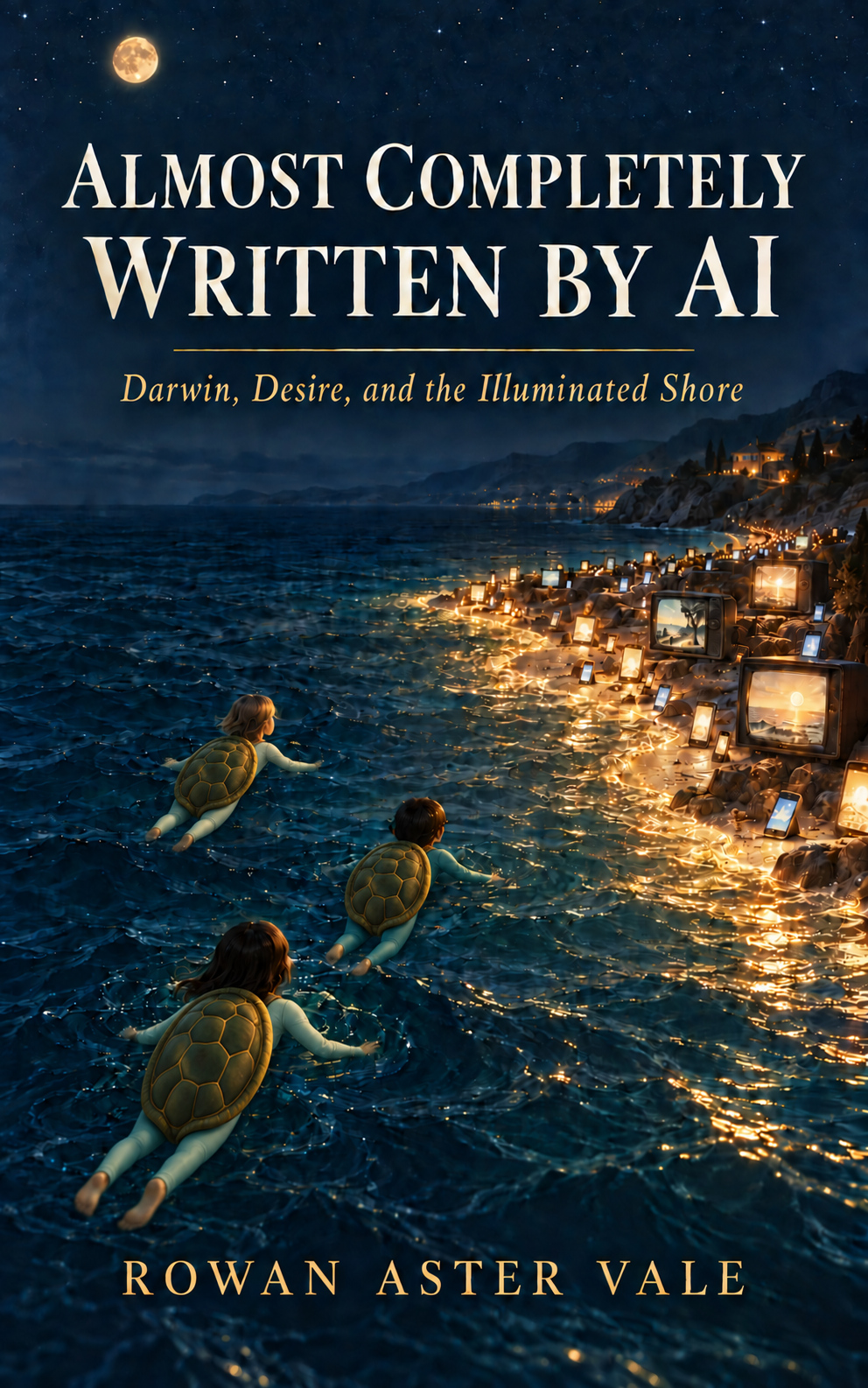
That is a different choice from feedback-only assistance. If you choose generated prose, label it in your working files, review it closely, and disclose its use wherever required. This guide’s worksheet defaults to preserving your wording. The case study explains the different approach used for Almost Completely Written By AI.
For a broader reflection on shaping assistance around your judgment, explore AI: An Extension of You. You can use this guide and worksheet without buying either book.